
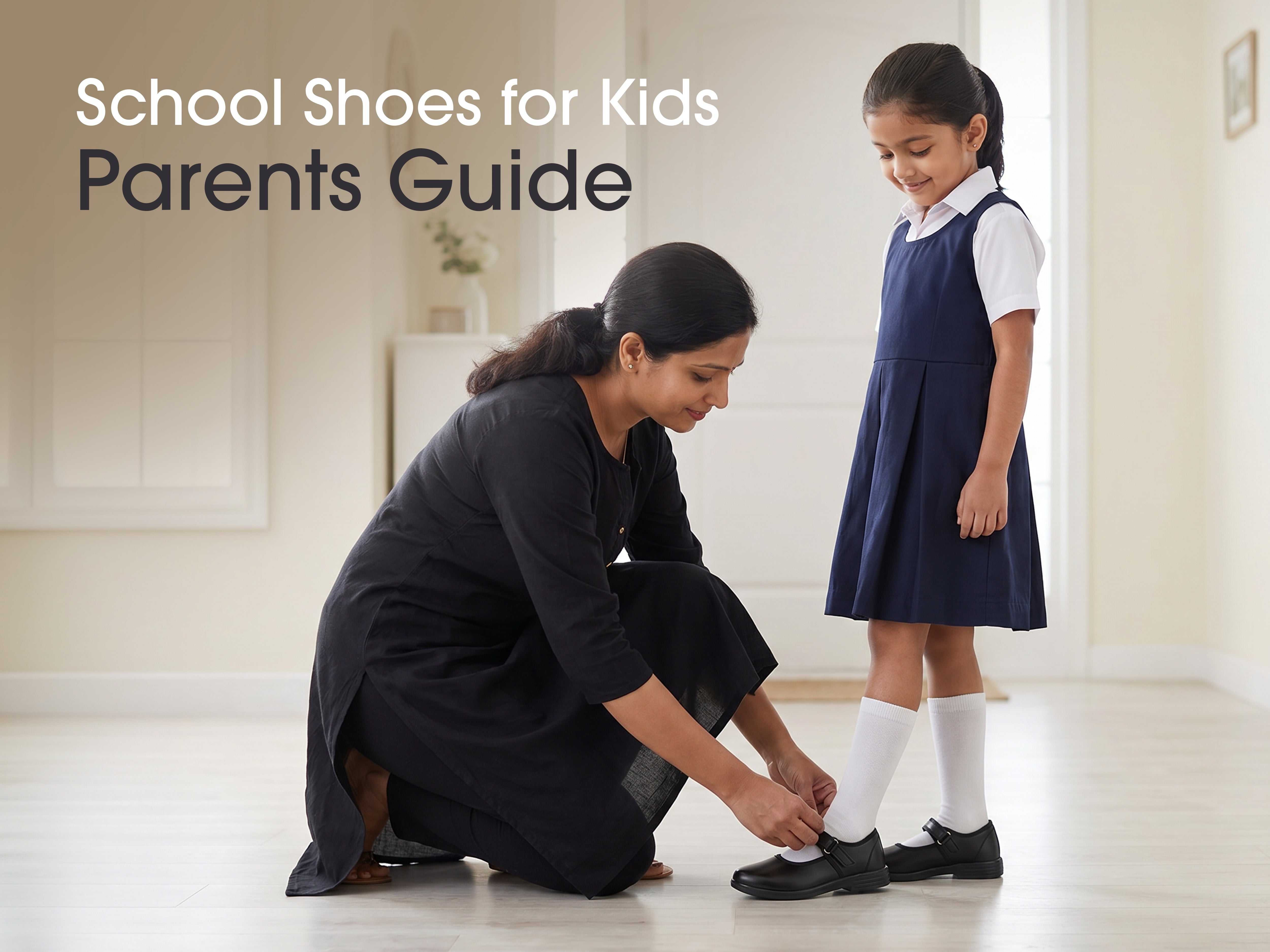
Every school season, the same question does the rounds in every household — which pair of school shoes for kids will actually survive the year? Not just Monday morning, but muddy playgrounds, back-to-back PE days, and that one kid who drags their feet on every surface. You think it'll be quick. Then you're standing in the shop with a restless seven-year-old and what looks like the same shoe in twelve slightly different boxes.
What nobody tells you upfront is that kids school shoes carry more responsibility than most footwear. Months of daily wear on growing feet adds up. That's why so many parents now look at the Top shoe brands in India and Best shoe brands in India first — because a name that's been tested across millions of school runs tends to get the fundamentals right.
Why School Shoe Choice Impacts a Child's Foot Development?

Children's feet are still developing well into their early teens. Unlike adult feet, they're soft, moldable, and quick to adapt — including to bad footwear.
A shoe that pinches, gives no support, or lets the heel float around doesn't just make the walk home unpleasant — over months, it can genuinely affect the way a child moves.
The right kids school shoes fit lets the foot do its job. Toes need space to spread. The arch wants support, not correction. The heel should feel anchored, not sliding around every time they sprint across the playground or stop sharply. When your child stops mentioning sore feet, or actually puts the shoes on without a fight, that's how you know.
6 Things Every Parent Should Check Before Buying School Shoes
Proper Fit & Toe Room
Press your thumb between the longest toe and the front of the shoe — that gap should exist in every pair. The best school shoes for kids aren't the ones that feel snug out of the box; they're the ones that feel right after a full school day. Shoes that feel "fine in the morning" often become the ones your child is quietly limping home in. That thumb-width of room isn't wasted space, it's where healthy toe movement happens.
Non-Slip Sole for Active Kids
Wet tile near the water fountain, freshly mopped corridors, damp grass during morning assembly — school environments are full of surfaces that catch children off guard. A non-slip sole on comfortable school shoes for kids is less about caution and more about letting them move without thinking twice. Test the sole yourself before buying: bend it, twist it slightly. Grip with flexibility is what you're looking for.
Breathable Material to Prevent Sweat
Pick up a pair of non-breathable shoes after a full school day and you'll understand immediately. Ventilation matters — not just for freshness, but for skin health. In Indian school conditions, where heat builds up quickly, materials that allow airflow are the difference between feet that feel fine at 3pm and feet that don't. It's rarely the feature on the label but it's always the one that gets noticed.
Easy On/Off - Velcro vs Laces by Age
Velcro for younger children is a practical call, not a lazy one. It builds independence, speeds up mornings, and eliminates the mid-PE-lesson untied lace problem entirely. When buying school shoes for boys or school shoes for girls in older age groups, lace-ups are worth considering — they allow a more precise fit that Velcro simply can't replicate. The honest guide: if your child can tie laces reliably and quickly, laces. If not, Velcro every time.
Durability: Will It Survive a Full School Year?
School shoes don't get treated gently, and they're not supposed to be. What matters is whether the construction can take it. Check the stitching where the sole meets the upper — that's where cheaper shoes start separating around month three. Look at the toe cap reinforcement. Feel the upper material. Brands from the Best shoe brands in India that are built for school use design specifically for this kind of daily punishment, not for looking good on a shelf.
Boys vs Girls School Shoes - Are There Real Differences?
Mostly in styling. Style-wise, School shoes for boys tend to be chunkier and more athletic-looking; girls' styles often run slimmer with a few more finish options. But underneath all that, the structural requirements are exactly the same — flexibility, cushioning, heel support, and a fit that doesn't restrict movement. Any parent who's bought a beautiful-looking pair that fell apart in six weeks knows that style is the last thing to optimize for.
Best Walkaroo School Shoes for Boys & Girls (Age-Wise Guide)

Walkaroo's school range was clearly designed by people who understood the brief: shoes that handle what school actually involves. For younger children, the Velcro styles close firmly and hold up across the day without loosening. Older students have lace options that offer a more dialed-in fit, particularly useful for children with narrow or wider-than-average feet.
The weight is worth noting. Lighter soles with proper cushioning mean that by 3pm, your child isn't dragging their feet — literally. That fatigue you see in kids after a long school day is partly footwear-related, and it's something Walkaroo's cushioned insoles genuinely address.
Back-to-school shopping is also a good time to sort out a school essentials hamper — socks, shoe polish, the small things that get forgotten. A kids care hamper or a back-to-school hamper bundles these together and removes the three separate follow-up trips to the shop that somehow always happen anyway.
For girls shoes and boy's shoes that are built to last a full school year, Walkaroo's school collection is worth a look before stock runs thin near-term start.
How to Measure Your Child's Foot Size at Home
Grab a blank sheet of paper and a pen. Have your child stand on it. Weight fully on the foot and trace around it. Also, by marking the back of the heel and the front of the longest toe. Measure that line. That's your working length.
The part most people skip: do both feet. One is almost always slightly larger. That's the measurement you buy for. Getting this right at home before shopping means fewer in-store surprises. It works just as well when buying kids school shoes online as it does in person.
How to Keep School Shoes Clean - Weekly Routine for Kids
The daily habit is simple: a damp cloth before the mud dries. Once it's set into the seams, it's much harder to shift.
Once a week, mild soap and a soft brush takes care of the rest — edges, seams, the creases that collect grime. The one rule that matters most for drying: no direct heat. Radiators and hairdryers break down the adhesive and warp the sole. Leave them to dry at room temperature, away from direct sun.
For black leather or synthetic shoes (comfortable school shoes for kids), a thin layer of polish once a week keeps the color from fading and the material from drying out. Ten minutes, once a week. That's genuinely all it takes.
Shop Walkaroo School Shoes for Boys & Girls
Explore stylish and durable school shoes for kids from Walkaroo. Find comfortable designs for boys and girls that support active school life every day.
Visit us at walkaroo.in
FAQs
1. How do I choose the right school shoes for my child?
Fit and grip first — everything else can wait.
2. What are the best types of school shoes for kids?
Lightweight, cushioned, breathable, and a sole that actually bends.
3. How often should I replace my child's school shoes?
Every 8–12 months, or sooner if the sole's gone or your child's feet are hurting.
4. What size should I buy for a growing child?
Leave a thumb's width at the toe, and when in doubt, size up.
5. Are leather school shoes better than synthetic?
Leather lasts longer; synthetic is easier to look after — both do the job.
6. What should I actually look for in a good school shoe?
Good grip, some cushioning, breathable material, and a fit that suits the actual shape of your child's foot.
Share:
How Often Should You Replace Your Child’s Shoes? A Parent’s Growth Guide
How to Style Men’s Casual Sandals